
Production Equipment and Processing ServicesProcessing & Inspection
Based on the form of your material and your needs, we offer three processes: slitting, cut-to-length, and shearing. Sursun Metals also takes on contract processing. Please contact us.
Service Overview
Materials: copper alloy, aluminum alloy, stainless steel, bakelite sheet, and other coil and sheet materials. Mostly material with no rust-preventive oil applied.
How to Choose Among the Three Processes
| Item | Slitting | Cut-to-Length | Shearing |
|---|---|---|---|
| Input form | Coil | Coil | Sheet |
| Output form | Narrow coil | Flat sheets of a set length | Smaller sheet pieces |
| Dimension changed | Width | Length (and flatness) | Length and width (squaring sheet) |
| Common next steps | Progressive stamping | Laser cutting, NCT processing | Preparing small sheet blanks |
Slitting
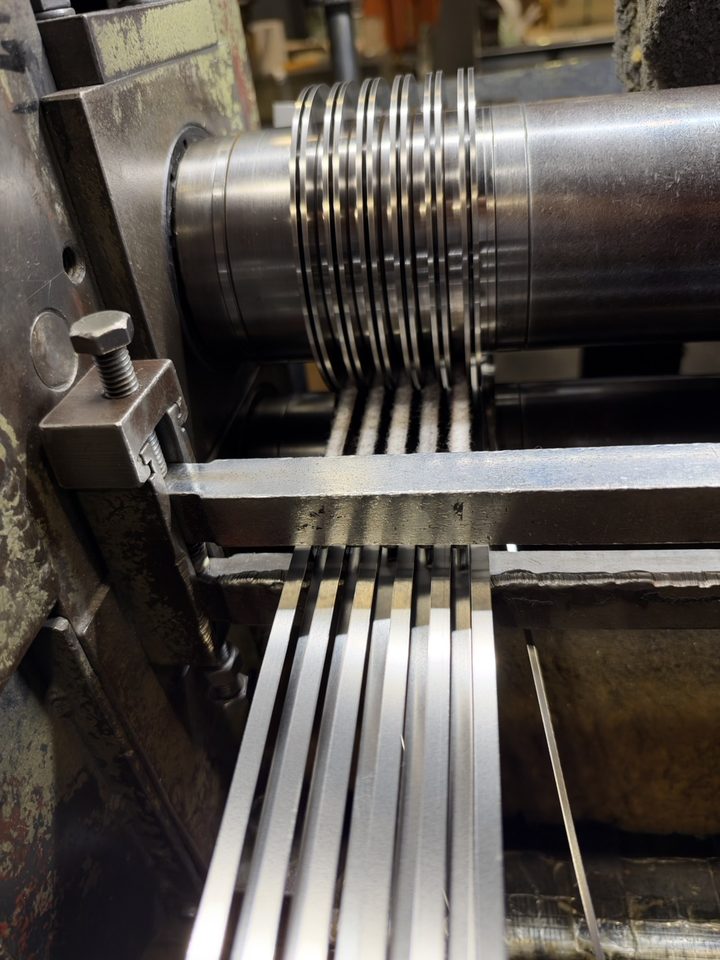
Cuts a full metal coil (master coil, also called mother coil) into several narrow coils of the width you need.
- The master coil is fed from the uncoiler into the slitter. Upper and lower circular knives cut it lengthwise at the set widths, and the recoiler then winds each strip into its own narrow coil.
- Protective film or interleaf paper can be applied. See “Surface Protection” below.
Good for
- You need narrow strip of a fixed width, for example for progressive stamping dies
- Your master coil is wider than your process needs, and must be cut into several strips

Size Range
| Item | Specification |
|---|---|
| Incoming coil width | Max. 1650 mm |
| Incoming coil weight | Max. 20 metric tons |
| Thickness range | 0.03–6 mm |
| Narrowest finished width | 2 mm |
Tolerance depends on the material, thickness, and cut size. Please contact Sursun Metals with any questions.
Process Steps
- Loading and uncoiling: The master coil is lifted onto the mandrel of the uncoiler and pushed into position. The mandrel expands to hold the inside diameter of the coil, and a hold-down arm presses on the outer edge to keep the coil from loosening.
- Threading: The leading end of the coil is guided into the downstream equipment, and the curve at the head is straightened.
- Slitting: Upper and lower sets of circular knives are set to the required widths and cut the full-width coil lengthwise into several narrow strips.
- Edge trim winding: The edge trim cut from both sides is wound up and collected by the edge trim winder.
- Looping and tensioning: The strips pass through a loop pit and a tension stand. These take up the small length differences between strips caused by slight variations in thickness or hardness, so that tension is even on every strip when it is recoiled.
- Recoiling: The strips are separated by spacers and wound into separate narrow coils. A coil car then unloads the coils, and they are strapped and packed.
Cut-to-Length
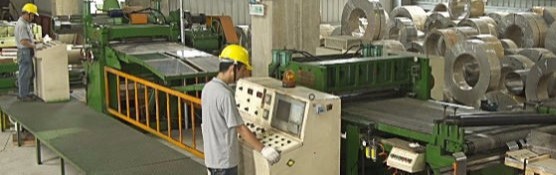
Uncoils, levels, measures, cuts, and stacks metal coil into flat sheets of a set length. This removes internal stress and curvature, and keeps the flatness and accuracy needed for later stamping, laser cutting, and CNC machining.
- During leveling, the material passes through many small-diameter work rolls arranged in an upper and lower staggered pattern. It is bent up and down repeatedly until it is flat, which removes coil curvature and greatly reduces residual stress. We use a roller leveler.
- Protective film or interleaf paper can be applied. See “Surface Protection” below.
Good for
- You need flat sheets of a set length for stamping, laser cutting, or CNC machining
- Internal stress or curvature in the coil distorts later processing, so the material must be leveled first
Size Range
| Item | Specification |
|---|---|
| Incoming coil width | Max. 1650 mm |
| Incoming coil weight | Max. 15 metric tons |
| Thickness range | 0.1–6 mm |
| Length range | 50–6000 mm |
Tolerance depends on the material, thickness, and cut size. Please contact Sursun Metals with any questions.
Process Steps
- Loading and uncoiling: The coil is loaded onto the uncoiler, and a hold-down arm presses on the outer edge to keep the coil from loosening.
- Threading: The leading end of the coil is guided into the downstream equipment, and the curve at the head is straightened.
- Leveling: The coil passes through a roller leveler. Many small-diameter work rolls and backup rolls, arranged in an upper and lower staggered pattern, bend the material repeatedly in the elastic and plastic range. This greatly reduces internal stress and distortion and brings the material to the flatness required.
- Measuring length: A measuring device counts the length of coil that has advanced.
- Cutting to length: When the coil reaches the set length, it is cut across. Flying shear or stop-and-cut is used depending on the need:
- Flying shear: the cutting unit travels at the same speed as the coil and cuts while moving, so the coil does not need to stop.
- Stop-and-cut: the coil stops moving before it is cut.
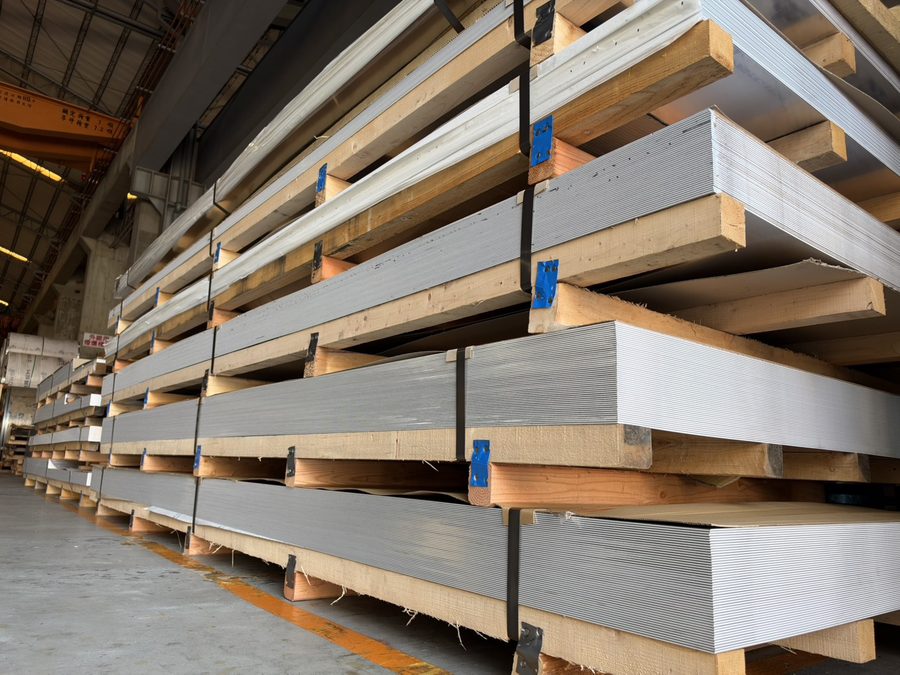
- Conveying and stacking: The cut sheets are carried by conveyor to the end of the line, stacked neatly, and packed.
Machine video
Shearing
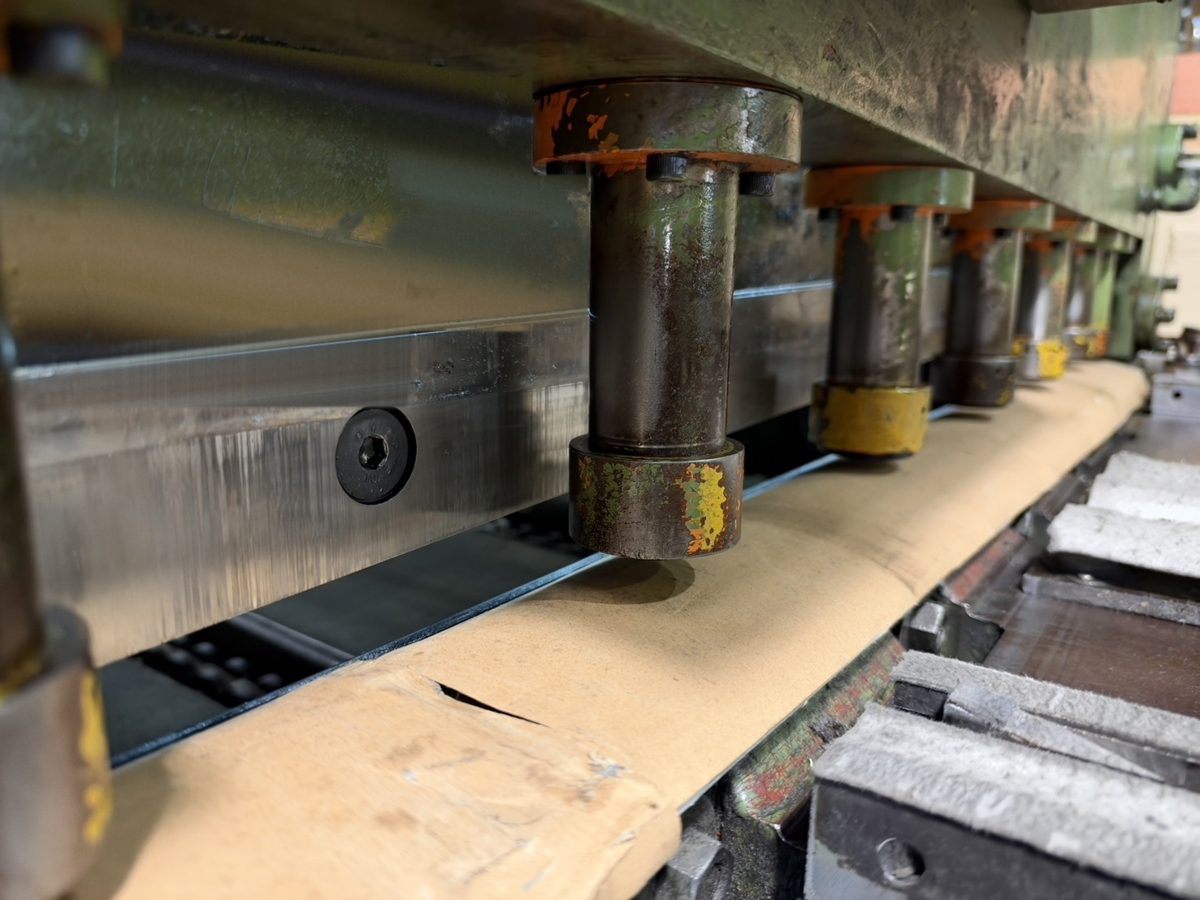
Uses an upper and a lower blade to cut large metal sheets into the smaller sizes you need. It handles sheet only and suits rectangular shapes.
- The lower blade is fixed, and the upper blade comes down to cut the sheet in a straight line.
Good for
- Sheet (or sheet already cut to length) needs to be cut into smaller rectangles
- Small batches with many different sizes
Size Range
| Item | Specification |
|---|---|
| Sheet width | Max. 1550 mm |
| Thickness range | 0.15–6 mm |
| Length range | 20–1525 mm |
Tolerance depends on the material, thickness, and cut size. Please contact Sursun Metals with any questions.
Process Steps
- Setting the size (back gauge): A motorized backgauge moves to the set size and decides the cut size.
- Placing and aligning the sheet: The sheet is laid flat on the table and pushed against the backgauge and side guide, so the corners are square and the size is right.
- Clamping: When the cycle starts, the hydraulic hold-down cylinders come down first and fix the sheet to the table. This keeps the sheet from lifting or shifting from the reaction force at the moment of cutting.
- Shearing: The upper blade comes down at a slight angle (the rake angle) and works with the fixed lower blade to shear the sheet. The cut moves from one end to the other and cuts the sheet along a straight line.
- Unloading and collecting: After the cut, the hold-down cylinders release. The cut sheet slides to the collection area at the back, where it is stacked and packed.
Surface Protection: Protective Film and Interleaf Paper
Protective film or interleaf paper on the material surface reduces rubbing marks and scratches. We generally suggest applying film at the first cutting step.
Protective films come in different types by material, adhesion, and use, such as PVC film, PE film, and fiber laser film. Please ask us which materials and thicknesses film and interleaf paper can be used with.
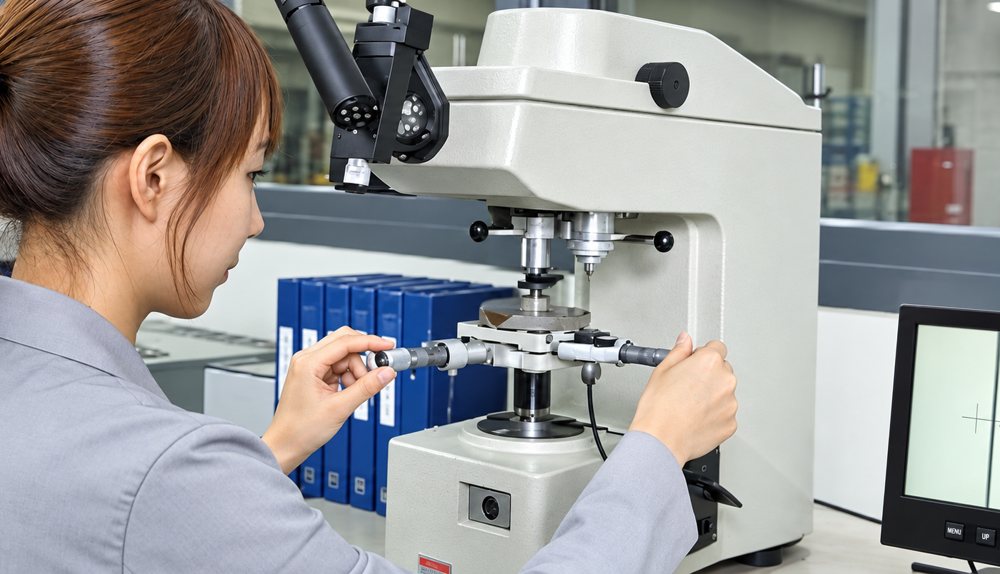
Inspection equipment: hardness tester
Sursun Metals has a Vickers hardness tester. It measures the indentation under a microscope to check the hardness of metal sheet.
The Vickers hardness test uses a square-based diamond pyramid indenter with a 136° angle between opposite faces. It is pressed into the surface of the test piece with a set force and held for a set time, then removed. The lengths of the two diagonals of the indentation are measured and converted to a Vickers hardness value (HV). Because the indentation is very small, the test suits thin sheet, thin strip, and small test pieces.
Cutting and Processing FAQ
What metal cutting services does Sursun Metals offer?
You can supply your own metal coil or sheet. We can then do slitting, cut-to-length, and squaring shear cutting for you.
What is the difference between slitting, cut-to-length, and shearing?
Slitting cuts a full metal coil into several narrow coils. This changes the width. Cut-to-length (leveling and cutting) uncoils the coil, levels it, and cuts it into flat sheets of a set length. This sets the length and removes curvature and internal stress. Shearing (Squaring Shear) uses an upper and a lower blade to cut sheet into smaller sizes.
Which materials can you process?
We process copper alloy, aluminum alloy, stainless steel, carbon steel, nickel, bakelite sheet, and other coil and sheet materials with no rust-preventive oil applied.
What size range can you slit?
Maximum incoming coil width is 1650 mm. Maximum coil weight is 20 metric tons. Thickness ranges from 0.03 to 6 mm. The narrowest finished slit width is 2 mm. Tolerance depends on the material, thickness, and cut size. Please contact Sursun Metals with any questions.
What size range can you cut to length?
Maximum incoming coil width is 1650 mm. Maximum coil weight is 15 metric tons. Thickness ranges from 0.1 to 6 mm. We can cut lengths from 50 to 6000 mm. Tolerance depends on the material, thickness, and cut size. Please contact Sursun Metals with any questions.
What size range can you shear?
Maximum sheet width is 1550 mm. Thickness ranges from 0.15 to 6 mm. We can cut lengths from 20 to 1525 mm. Tolerance depends on the material, thickness, and cut size. Please contact Sursun Metals with any questions.
Why does coil need to be leveled?
Coil keeps some curvature (coil set) and internal stress from being wound. Leveling reduces this stress and makes the sheet flatter. Sheet that is not flat can reduce the accuracy of later stamping, laser cutting, or CNC work.
What is the tolerance after cutting?
Tolerance depends on the material, thickness, and cut size. Please contact Sursun Metals with any questions.
Questions about processing quotes or requirements
Please contact Sursun Metals